If you’ve ever stopped to watch a professional-grade PVC pipe in action—whether it’s for a lab’s fluid transfer system, a medical device’s component, or a high-end irrigation setup where light penetration is critical for monitoring flow—you might have wondered: can a PVC pipe machine actually produce pipes with a high degree of transparency? As a third-generation PVC pipe machinery supplier, I get this question all the time, not just from new customers testing the waters, but from long-time partners upgrading their production lines. Today, I want to break down this question the way I do for every inquirer: not with marketing fluff, but with the actual science of extrusion, the role of equipment design, and the real-world results we deliver to clients across industries. PVC Pipe Machine
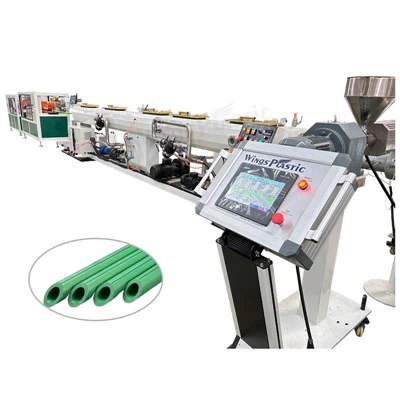
First, let’s clear up a common misconception: PVC isn’t inherently opaque. When you take pure, unplasticized PVC resin, heat it to the exact temperature it softens (around 180–200°C, depending on the formulation), and process it without introducing contaminants, the material is naturally semi-translucent. The issue is that most mass-produced PVC pipes we see for plumbing, construction, or drainage are formulated with additives that either boost durability, lower production costs, or meet regulatory standards—and those additives are often what make the final product cloudy or opaque. So the path to transparent PVC pipes starts long before the material touches the machine’s hopper; it starts with custom resin and additive selection, and then relies on a PVC pipe machine that can preserve that material’s clarity through every step of the extrusion process.
Let’s walk through the extrusion process step by step, because this is where most transparent pipe projects succeed or fail. When a PVC pipe machine processes material, the first key component is the extruder screw and barrel. If these parts have rough surfaces, or if they’ve been worn down by years of processing recycled PVC (which often has leftover pigments or fillers), they can shear the PVC resin molecules. Shearing breaks the long polymer chains that give PVC its clarity, turning smooth, light-transmitting polymer strands into shorter, tangled molecules that scatter light—creating that cloudy white or gray haze most people associate with standard PVC. That’s why, for transparent PVC production, we machine our extruder barrels and screws from polished, high-grade stainless steel, with a mirror-like internal surface and precision-machined screw threads that apply consistent, low-shear pressure. No sharp edges, no worn spots, no inconsistent pressure points—just a smooth flow of evenly heated, undamaged resin.
Next comes the die head, the part of the PVC pipe machine that shapes the molten resin into the pipe’s specific diameter and wall thickness. This is another make-or-break component for transparency. If the die isn’t designed to maintain a uniform, thin wall (for smaller diameter pipes, especially), or if there are dead zones in the die where molten resin can get stuck and degrade, that trapped material will have a different molecular structure than the rest of the pipe. Degraded PVC turns yellow or cloudy, and uneven wall thickness causes light to refract inconsistently across the pipe’s surface, ruining clarity. Our die heads are custom-machined to match each client’s exact pipe specifications, with streamlined internal channels that eliminate dead zones, and we use thermal profiling to keep the entire die at a consistent temperature (within ±2°C) from inlet to outlet. That ensures the molten resin flows evenly, cools uniformly, and retains its molecular structure from start to finish.
Cooling is the third critical step, and it’s one that many new machine operators get wrong. When PVC cools too quickly, or unevenly, it forms tiny, uneven crystal structures within the polymer matrix. Those micro-crystals scatter light, just like sand in water, making the pipe cloudy. For transparent PVC pipes, we rely on a two-stage cooling system integrated into our PVC pipe machines: first, a vacuum sizing tank that pulls the molten pipe tight against a precision-sized metal mandrel, maintaining consistent wall diameter while the resin cools slowly enough to form small, uniform crystals rather than large, scattering ones. Then, a secondary spray cooling section that brings the pipe to room temperature gradually, with temperature-controlled water that prevents thermal shock. I can tell you firsthand the difference this makes: a client in the food and beverage industry brought us a sample of a transparent PVC pipe they’d produced with a budget machine, and when we tested it under polarized light (a standard method for measuring light transmission in polymers), it had only 62% clarity. We adjusted the cooling profile on our machine to match their die specifications, and the same resin gave them a pipe with 94% clarity—enough to easily see small particles in the water flowing through it, which was exactly what they needed for their liquid packaging line.
Now, let’s talk about variables that are within the operator’s control, because even the best machine won’t fix mistakes on the plant floor. First, material purity. If you’re using PVC resin with leftover pigments, fillers, or plasticizers from previous runs, or if you’re adding low-quality additives (like cheap lubricants that don’t mix evenly), you’ll get a cloudy pipe. We work with every transparent pipe client to recommend food-grade or medical-grade resin suppliers that offer pure, virgin PVC with consistent molecular weight, and we even provide pre-run purge protocols for our PVC pipe machines to clear out any residual material between production runs. Another variable is temperature monitoring: if the extruder’s heating zones are set too high, the PVC resin will thermally degrade, breaking molecular chains; too low, and the resin won’t melt evenly, leaving unplasticized clumps that scatter light. Our machines come with digital, real-time temperature sensors that track every zone (hopper, barrel, die, cooling sections) and alert operators immediately if settings drift outside the optimal range.
I know some customers ask me if it’s worth investing in a high-spec PVC pipe machine for transparent pipes, especially when mass-produced opaque PVC is cheaper to make. Let’s look at real applications to answer that. A pharmaceutical client in Germany reached out to us two years ago, needing small-diameter transparent PVC pipes for their IV fluid delivery systems. They’d been using a competitor’s machine, but their pipes had too much haze, making it hard to verify flow rate and check for air bubbles mid-infusion. After switching to our custom PVC pipe line, they were able to produce pipes with <0.5% haze (measured via ASTM D1003, the standard test for plastic light transmission) and consistent wall thickness within 0.02mm, which cut their quality control inspection time by 40% because they could easily spot defects visually. Another client, a small-scale hydroponics farm in Oregon, uses our machine to make ½-inch transparent PVC pipes for their nutrient delivery systems. Being able to see the nutrient flow lets them detect clogs early, reducing crop loss by 18% in their first year using our equipment.
Now, to address the flip side: are there limits to what a PVC pipe machine can produce in terms of transparency? Yes, and they’re tied to material science, not machine capability. For pipes larger than 4 inches in diameter, it’s far harder to maintain uniform cooling across the entire wall thickness, so clarity tends to drop slightly as diameter increases. Also, if a client needs UV resistance, adding UV stabilizers can slightly reduce clarity (though modern UV stabilizers have minimized this effect). But for all standard pipe sizes below 6 inches, and for most applications that require transparency, our PVC pipe machines consistently deliver pipes with clarity levels that meet or exceed industry standards for medical, food, hydroponic, and lab use.
As a supplier who’s been working with PVC extrusion equipment for over 25 years, I’ll be straight with you: you can’t take a standard, off-the-shelf PVC pipe machine designed for mass-produced opaque pipes and expect it to turn out transparent pipes. The difference is in the precision of the components, the thermal control, and the low-shear design that preserves PVC’s molecular structure. Every client we work with for transparent pipe projects gets a custom consultation: we review their desired pipe size, application, clarity requirements, and production volume, then adjust the machine’s components (die head, screw, cooling system) to match. We don’t sell a one-size-fits-all machine and walk away; we provide on-site training for operators, ongoing maintenance support, and even material testing services to make sure their production meets their exact needs.
If you’re looking to venture into transparent PVC pipe production, or if you’re struggling with inconsistent clarity from your current machine, I’m here to help. We’ve helped dozens of clients across industries set up or upgrade their lines to produce high-transparency PVC pipes, and we can tailor a solution to fit your production goals and budget. Reach out to our team to talk through your project details, and we can provide a free initial assessment and performance specs tailored to your needs.
Plastic Corrugated Pipe Machine References
ASTM D1003-21, Standard Test Method for Haze and Luminous Transmittance of Transparent Plastics
Krevel, D. W. (2009). Polymer Extrusion: Principles and Practice. Hanser Publications
European Committee for Standardization. (2018). EN 1565-1: Plastics piping systems for water supply – Unplasticized poly (vinyl chloride) (PVC-U) pipes and fittings – Part 1: Specifications.
Qingdao Wings Plastic Technology Co., Ltd.
As one of the most experienced pvc pipe machine manufacturers and suppliers in China, we also support customized service. Please feel free to buy durable pvc pipe machine made in China here from our factory. For price consultation, contact us.
Address: C02 Of Anshengyi Road, No.2 Fuan Industry Zone,Jiaodong Town, Jiaozhou City, Qingdao City, Shandong Province,China
E-mail: kelly@wingsplastic.com
WebSite: https://www.wingsextruder.com/
