If you’ve ever spent time designing machinery, automotive parts, medical devices, or even simple home repair projects, you’ve probably stared at a compression spring and thought, “It’s just a coil of metal—how much can changing something small about it really matter?” When I first started in the compression spring supply business over 12 years ago, I thought the same thing. Back then, if a client asked for a spring that fit in a 1-inch hole and exerted 10 pounds of force at a 0.5-inch deflection, I’d just pull a part number off our shelf and ship it. I learned quickly that one tiny detail, easy to miss if you’re not looking closely enough, can make or break a project: the number of active coils. Compression Spring
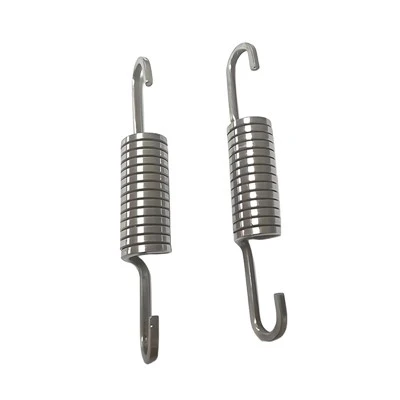
Active coils aren’t just the loops you count when you’re holding a spring in your hand. Let’s break that down first, because it’s the root of every performance effect we see. Every compression spring has two types of coils: active and inactive. Inactive coils (sometimes called “dead” coils) are the ones at the very ends of the spring. We grind and square these ones for most applications, right? Their job is to sit flat against a mounting surface so the spring doesn’t tip or rock when compressed. They don’t twist or flex when force is applied, though—they just hold the shape. The active coils, on the other hand, are the middle loops that do all the work. When you press a compression spring, it’s the active coils twisting and bending against the metal’s resistance to that movement that create force, deflection, and all the other performance numbers designers care about.
I remember a client a few years back, a small engineering firm making surgical staplers. They came to us with a prototype that kept failing before it even made it to testing. Their original spring had 8 total coils, and they thought all 8 were active. When we tested it in our lab, though, it only had 6 active coils. When they swapped it out for a spring with the same wire diameter, outer diameter, and total length, but 7 active coils, the stapler worked exactly as intended. That’s the kind of issue that costs projects weeks of delay, not to mention thousands of dollars in prototyping costs, all because someone didn’t pay attention to how active coils interact with spring performance.
So let’s get into what actually happens when you change the number of active coils. The first big performance metric is spring rate, often called “k” for short. Spring rate is how much force a spring exerts per unit of deflection—think pounds per inch or newtons per millimeter. The formula for spring rate is straightforward, and it centers almost entirely on active coils: k = (G * d⁴) / (8 * D³ * N_a). Let me translate that plain English, because I know formulas can sound like jargon. G is the shear modulus of the metal (that’s how stiff the wire itself is, steel is way stiffer than brass, for example), d is the wire diameter, D is the outer diameter of the spring, and N_a is the number of active coils.
What does that mean in real terms? If all other variables stay the same—same wire, same thickness, same overall size—adding more active coils makes the spring softer, lowering its rate. Removing active coils makes it stiffer, raising the rate. That’s why that surgical stapler worked better with one extra active coil: the original spring was too stiff, so it was exerting too much force too early in the compression cycle. Adding one active coil lowered the rate just enough to align with the exact force curve they needed for the stapler to fire without jamming or injuring tissue. I’ve seen this play out in dozens of industries since then. In automotive valve springs, for example, a slight adjustment to active coils can mean the difference between an engine that revs smoothly at 6,000 RPM and one that loses power or experiences valve float. In small appliance door latches, too many active coils and the spring feels mushy when you close the door; too few, and it slams too hard, bending the latch over time.
But spring rate isn’t the only performance factor tied to active coils. Next, there’s solid height, and how active coils affect that. Solid height is the compressed height of the spring when it’s fully crushed, with all coils pressed together. At first glance, you might think solid height is just total coils times wire diameter, right? That’s true if all coils are active, but not if you have inactive coils at the ends. Wait a second—if active coils only make up part of the total, how does that tie to performance? Let’s go back to the surgical stapler example. That spring needed a solid height no taller than 0.3 inches to fit in the stapler’s handle. If we’d adjusted active coils without accounting for solid height, we could have added so many active coils that the solid height exceeded that maximum. That’s where the line between active and inactive coils becomes critical. Inactive coils don’t affect solid height the same way active coils do. If you have 2 inactive coils (1 on each end) and 6 active coils, total coils are 8. Solid height would be wire diameter times 2, not 8, because the 6 active coils just lie flat when crushed, same as the dead ones. That’s a key point for designers: when you’re spec’ing spring length and solid height, you have to account for active vs. inactive coils, not just total.
Another big one is fatigue life. That’s how many times a spring can compress and release before it breaks or loses its rated force. At this point, you’re probably wondering: how does the number of active coils play into that? It all comes down to stress distribution across the spring. The formula for maximum shear stress in a spring is τ = (8 * D * F) / (π * d³) * K, where K is the Wahl factor that accounts for curvature and direct shear. That formula doesn’t have N_a in it, right? So why would active coils affect stress? Let me explain. All other factors equal, if you have a spring with more active coils, it deflects more for the same load, right? So the strain in each individual coil is lower. Less strain means lower cyclic stress, which means less fatigue. I worked with a farm equipment manufacturer a couple of years back who had a picker mechanism spring that was failing every 3 months. They were using a 10-coil spring, 2 of which were inactive at the ends. We swapped it for a spring with the same wire, diameter, and total length, but 12 active coils—so we removed one inactive coil from each end, made them active instead. The fatigue life jumped to over 18 months, well above their warranty requirement. Why? The extra two active coils meant the spring deflected more under the same load, so each coil experienced less stress as it twisted. Fewer cycles of high stress = longer life. That’s not to say more active coils are always better for fatigue—if you overdeflect a spring to the point where coils touch each other, that creates localized stress points, which is bad. But when designed properly, adjusting active coils is a great way to extend cycle life for springs that are under high, repeated loads.
I also can’t talk about active coils without mentioning deflection range. The usable deflection of a spring is how much you can compress it before it reaches its solid height, minus any allowance you need to avoid overworking the metal. Again, this ties directly to active coils. Let’s do a quick example: suppose you have two springs, same wire diameter, same outer diameter, same total length, same solid height. Spring A has 5 active coils, Spring B has 10 active coils. Which one has a larger usable deflection? Spring B, obviously. More active coils mean the spring can stretch (or compress, for compression springs) further before it hits solid height. That’s crucial for applications where you need a lot of movement—like the suspension on a small robot, or a return spring for a heavy garage door. If you spec a spring with too few active coils, you’ll hit solid height before you reach the force you need, and you’ll have to replace it because you overcrushed it. We once had a client who was building robotic arms for warehouse order pickers. Their original spring had 6 active coils, and they were only getting 0.75 inches of usable deflection. They needed 1.5 inches to reach their full range of motion. By switching to a spring with 12 active coils, same other specs, they got exactly the deflection they needed, no redesign of the arm required. That’s the kind of small adjustment that solves big problems.
Now, I want to be honest here—this isn’t a “change active coils and everything works” situation. There are limits, and they’re real. First, you can’t just add as many active coils as you want. If you have too many, the spring will buckle when it’s compressed. Buckling is when the spring bends sideways instead of compressing straight, which makes it uneven, loses force, and can even break. The risk of buckling depends on the spring’s slenderness ratio: free length divided by outer diameter. For a compression spring, you want that ratio to stay below about 4 for most applications. If you go over that, you’ll need to add a center guide rod or use a spring with more active coils? Wait no—actually, more active coils can make buckling worse, because the spring is more flexible sideways. So if you need more active coils to get the right rate, you might have to increase the outer diameter to keep the slenderness ratio low enough to avoid buckling. That’s a tradeoff we walk through with clients all the time. We had a medical device client who needed a very low spring rate for a needle injector, so they needed 14 active coils. Their original outer diameter was too small, so adding 14 active coils would have made the ratio 4.8, which was way too high for a medical application where consistency is non-negotiable. We increased their outer diameter just enough to bring the ratio down to 3.5, kept the 14 active coils, and they got exactly the soft rate they needed without buckling or side movement.
Another limit: if you have too few active coils, you might not be able to get the spring rate you need without increasing wire diameter or outer diameter, which might not be possible for your application’s size constraints. That’s why working with a supplier who understands active coils isn’t just nice—it’s necessary, especially if you’re working on a tight space or strict performance requirements. I’ve had designers come to us with a spec that looks great on paper, but they don’t realize they’ve miscalculated active coils, and a little adjustment fixes everything without changing the overall size of the part.
Let me wrap this up with a lesson I’ve learned over 12 years in the spring supply business. So many engineers, even experienced ones, focus on the obvious spring specs: wire diameter, outer diameter, total length, material. Those are important, don’t get me wrong. But the number of active coils is the hidden variable that can make your spring work perfectly or fail unexpectedly. It’s not just a number you count while holding a spring. It’s the thing that controls how soft or stiff your spring is, how much movement it can handle, how long it will last, and whether it will stay stable when compressed.
When you’re designing a new part or replacing a worn spring, don’t just go by the old part’s part number. Pull it apart, count the active coils (remember, the ones that aren’t at the ends, grinding marks on the ends mean they’re inactive), and if you have questions about how adjusting that number will affect performance, reach out. We don’t just ship springs here—we work through the math, the tradeoffs, the real-world performance, to make sure you get exactly what you need, no failed prototypes, no unexpected downtime, no part replacements down the line.
If you’re working on a project right now where your springs aren’t performing as expected, or you’re designing something new and want to get the active coils right from the start, don’t hesitate to connect with us. We have in-house lab testing, years of experience across every industry from medical equipment to agricultural machinery to automotive, and we’ll help you dial in every detail to get the performance you need.
Extension Spring References:
- Compression Spring Design Handbook. Spring Manufacturers Institute, 2020.
- Shigley’s Mechanical Engineering Design, 11th Edition. McGraw-Hill, 2020, Chapter 10: Spring Design.
- Mechanical Springs: Practical Design Guide. Robert L. Mott, Industrial Press, 2017.
- Fatigue of Metals and Components for Industrial Applications. David J. Waisman, CRC Press, 2019.
- Spring Buckling: Analysis and Prevention. European Spring Manufacturers Association, 2021.
Shengzhou Deyuxiang Hardware Accessories Co., Ltd.
We are one of the most professional compression spring manufacturers and suppliers in China, also support customized service. With abundant experience, we warmly welcome you to buy high quality compression spring made in China here and get pricelist from our factory. For price consultation, contact us.
Address: No. 38, Caosheng Road, Caoqiao Street, Pinghu City, Jiaxing City, Zhejiang Province
E-mail: 877286126@qq.com
WebSite: https://www.dyx-spring.com/
